
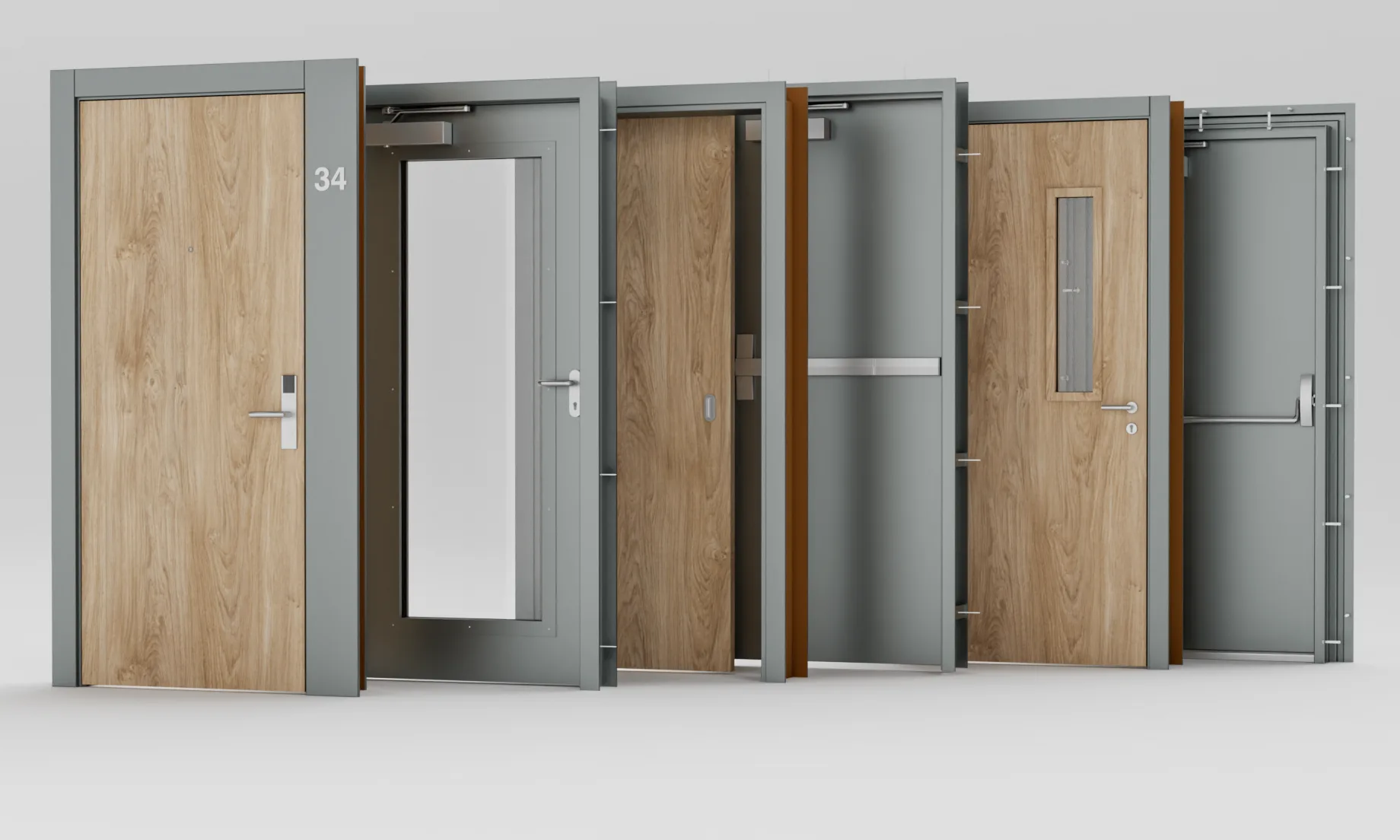
What is a fire door? A fire door is a tested, certified doorset that prevents flames, smoke and high temperatures from spreading between parts of a building for a defined period. Its job is twofold: contain the fire in its compartment of origin, and buy occupants safe evacuation time. An ordinary steel door — however solid it looks — is not a fire door unless it carries a test report.
Fire regulations require fire rated doors in escape stairs, fire safety lobbies, boiler rooms, shelters, archives and technical rooms, among many other spaces. In hotels, hospitals, schools, malls, dormitories and high-rise residential buildings, certified doors are indispensable for occupancy permits and fire brigade approval.
By location of use: escape stair doors, panic exit doors, glazed corridor doors, smoke control (S class) doors, shaft and service covers, acoustic + fire combination doors and wood-finish fire rated hotel room doors. By material, two families: steel fire doors (technical rooms, stairs, industry) and wooden/composite fire doors (hotels, hospitals, offices where aesthetics matter).
Doors are produced in 30, 60, 90 and 120 minute resistance classes. In a rating like "EI90", EI denotes integrity + insulation and 90 the minutes. The required class comes from the project's fire report; EI60 and EI90 are the most common. See our Certification Library for a full reading guide.
Common single-leaf sizes range around 90–100 × 200–220 cm; but in certified production the real limit is the maximum size covered by the test report. Our DMSteel series is certified up to 139×275 cm single leaf and 300×350 cm double leaf. Larger sizes rely on the report's "Category B" extended field of application — so door schedules must always be checked against the certification tables before quotation.
There is no single list price; six factors build the cost: (1) fire class and duration, (2) size and leaf count, (3) material and finish (galvanized paint, RAL, lacquer, laminate), (4) glazing/louver panels, (5) hardware level — panic bars, closers and electric locks vary widely by brand, (6) installation and freight. In the hunt for a "cheap fire door", the first items cut are seals, drop seals and certified hardware — precisely the parts that make the door work in a fire.
Does the door carry an accredited laboratory report, and does the report cover this size? Are the frame, seals and hardware part of the same report as the leaf? Who installs it, and is periodic inspection offered after commissioning?
At Doorsmar we cover the full journey with 21 TSE and Efectis certified steel models, a UL10c/EN 1634-1/BS-476 wooden series and FDIS-certified engineers — from survey to periodic inspection. Send us your door schedule; we'll return the right models and budget the same day.
Our engineers support you from site survey to installation. Send us your dimensions and required rating — we respond the same day.
Request a Quote +90 532 300 05 25