
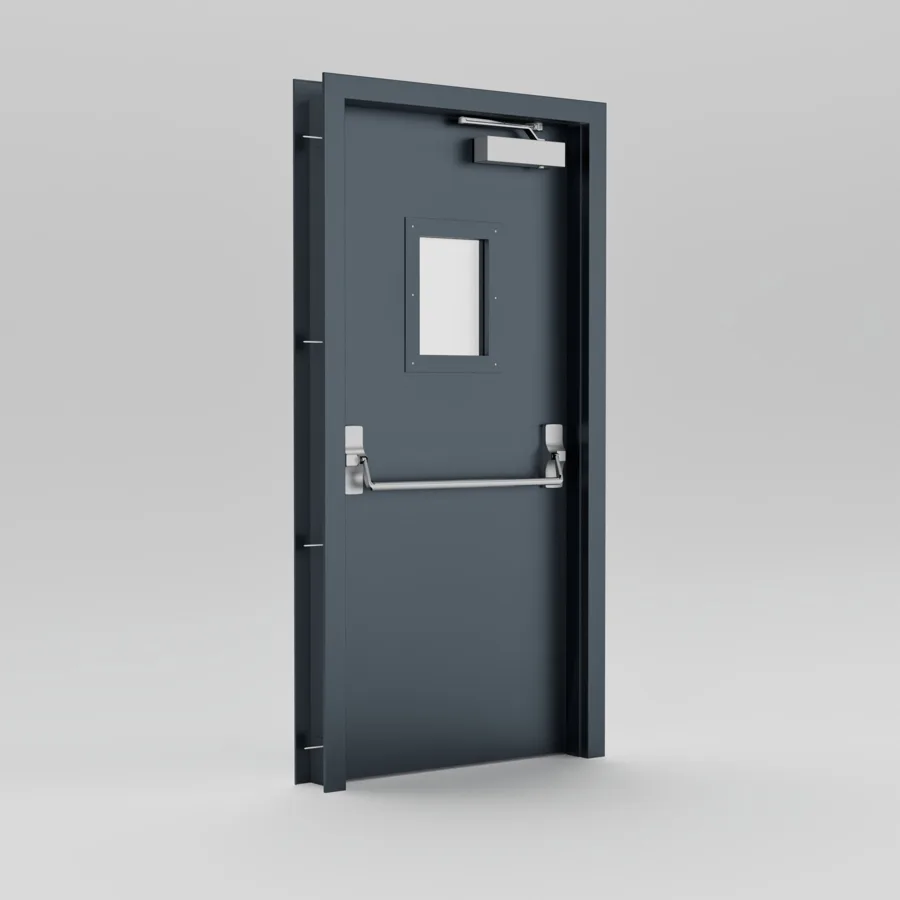
Fire safety brings flames to mind; yet the real threat is usually invisible. Smoke and toxic gases render escape corridors unusable long before flames reach a space — they kill visibility, destroy orientation and cause loss of consciousness within minutes. That is why modern regulations add a separate criterion beside fire resistance (E/EI): smoke control (S).
The S class is measured to EN 1634-3: the doorset's air leakage rate is tested under defined pressure differences. There are two sub-classes — Sa covers leakage at ambient temperature; S200 covers medium-temperature smoke up to 200°C. A door can be EI90 yet not smoke-tight; the two performances must be certified separately.
What seals a door is as much the detail around the leaf as the leaf itself: the smoke seal running the full frame perimeter, the drop seal that automatically closes the bottom gap on closing, and a properly adjusted closer that shuts the door fully every time. Break one link — the seal gets painted over, the drop seal removed, the closer loosens — and the door is no longer smoke-tight. Field audits indeed list torn, shortened, reversed or painted-over smoke seals among the most frequent causes of failure.
In buildings where evacuation is slow — hospital corridors, hotel floors, dormitories and care homes — the S class is a matter of conscience beyond regulatory duty. Doorsmar's MFD 90 SA and MFD G90 S200 models combine smoke tightness with fire resistance; every door ships with the Garlin DRS9100 automatic drop seal and tested seal systems. Let's design your project's smoke control strategy together — and see our inspection article on why maintenance matters.
Our engineers support you from site survey to installation. Send us your dimensions and required rating — we respond the same day.
Request a Quote +90 532 300 05 25